Arabie
 L’Arabie s’étend le long de la côte nord-ouest des Terres du Sud, entre les Montagnes Atalan et le Grand Océan. À l’est se trouve le Grand Désert qui sépare l’Arabie de la Terre des Morts. Bien que le climat de la région soit sec et chaud, les vents soufflant de l’ouest amènent leur lot de précipitations sous forme de nuages noirs venant se heurter aux sommets des Montagnes Atalan.
Les Arabiens sont de grands marins qui depuis des siècles pêchent dans les mers bordant leurs terres et s’en servent comme voie de commerce. Ils échangent des biens avec le Vieux Monde au nord et voyagent à l’ouest jusqu’en Ulthuan. Les Hauts Elfes ne permettent pas aux navires arabiens d’aller plus à l’ouest, mais leurs boutres mouillent fréquemment dans les ports extérieurs de Lothern. Pour leur part, les Elfes maintiennent des comptoirs commerciaux dans les villes arabiennes de Copher et Lashiek depuis des temps immémoriaux. Les elfes et les Arabiens ont toujours gardé contact, même lorsque les premiers abandonnèrent le Vieux Monde durant des siècles.
La portion la plus densément peuplée d’Arabie se trouve au nord de la Rivière du Serpent, cette dernière étant le plus grand cours d’eau de ces terres à ne jamais tarir. L’Arabie compte quatre grandes cité : Lashiek, Copher, Martek et Alhaka, aussi connue sous le nom d’Al-haikk (la Cité des Voleurs en Arabien). Chacune d’elles est entourée de terres qui forment des principautés indépendantes dirigées par un sultan ou un calife. Au sud de la Rivière du Serpent, les terres sont moins fertiles et bien plus arides. À l’est des Montagnes Atalan, le Grand Désert s’étend sur des centaines de lieues en direction de la Terre des Morts.
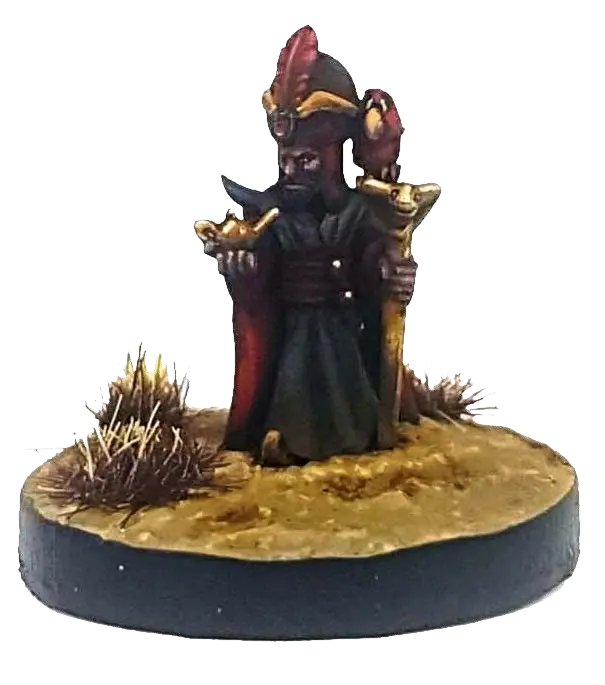
L’Arabie se trouve loin des pôles et de la source des vents magiques qui se déversent sur le monde. C’est pourquoi, si la magie est commune dans le Vieux Monde, elle est bien plus rare en Arabie où les sorciers ont des difficultés à exercer leur art. En conséquence, la magie arabienne s’est développée différemment de celles des autres nations humaines. Les sorciers arabiens emploient leurs pouvoirs pour contrôler les esprits élémentaires du désert, les djinns, les effrits, les génies et autres. Ces entités sont vénérées par les gens superstitieux d’Arabie qui croient qu’elles doivent être apaisées par des offrandes telles que de la nourriture.
Les dirigeants arabiens lèvent leurs propres armées dans les grandes villes et au sein des tribus vivant dans les terres alentour. Les chefs de ces tribus sont appelés émirs, ou cheiks dans le cas des nomades du sud et de l’est. Ceux qui gouvernent les cités portent le titre de sultan, et celui d’Alhaka est reconnu comme le Grand Sultan, commandeur suprême de toute l’Arabie.
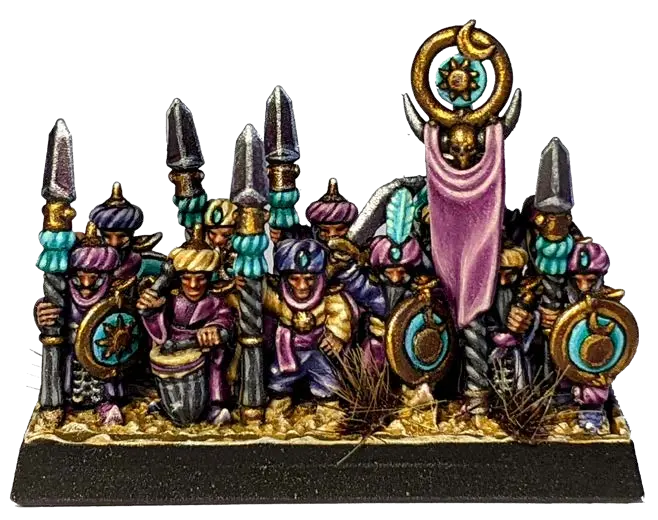
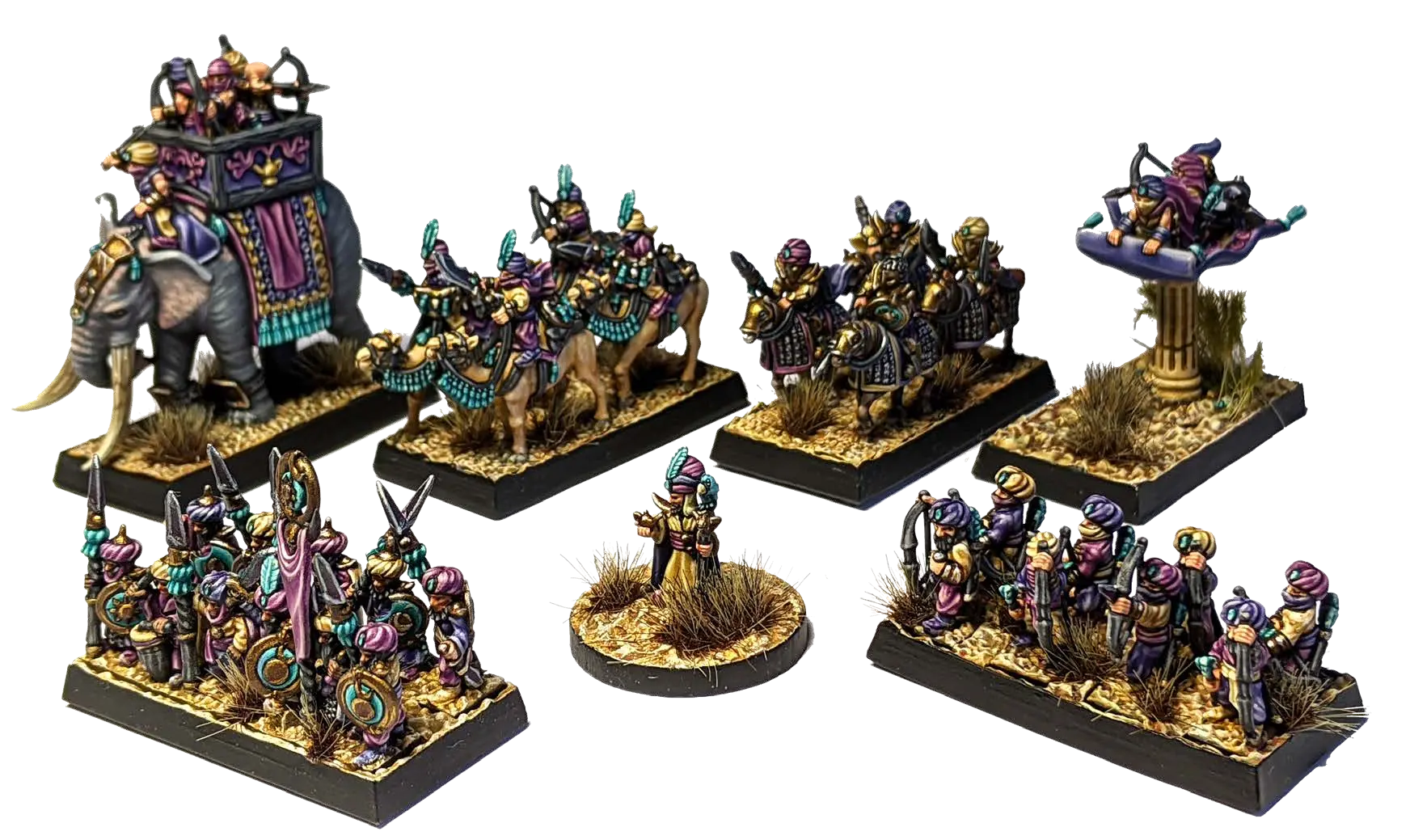
Les sultans sont fiers de leurs troupes et en particulier de leur cavalerie. La croyance veut que les chevaux arabiens descendent des coursiers elfiques qui furent amenés dans la région il y a des siècles. Ce sont des créatures d’une grande valeur, rapides et pleines de grâce. L’élite de l’infanterie arabienne est également très bien équipée, avec des armures d’acier poli, des tulwars tranchants et des vêtements de soie fine. Ces gardes prétoriens accompagnent les sultans lorsqu’ils quittent leurs palais féeriques et leur loyauté sans faille est amplement récompensée, les richesses et le luxe s’ajoutant au prestige. En plus de ces soldats réguliers et des troupes de garnison, un sultan peut compter sur les forces irrégulières tirées des tribus du désert, à l’instar des méharistes des terres du sud et de l’est.
Sélecteur d’Armée d’Arabie
| Troupe | Type | Attaques | Points de Vie (PV) | Armure | Commandement (Cdt) | Taille d’unité | Points par unités | Min/max | Spécial |
|---|---|---|---|---|---|---|---|---|---|
Lanciers |
Infanterie |
3 |
3 |
6+ |
– |
3 |
45 |
2/– |
– |
Archers |
Infanterie |
3/1 |
3 |
– |
– |
3 |
55 |
2/– |
– |
Gardes |
Infanterie |
3 |
3 |
5+ |
– |
3 |
65 |
–/4 |
|
Chevaliers |
Cavalerie |
3 |
3 |
4+ |
– |
3 |
110 |
–/– |
– |
Cavaliers du Désert |
Cavalerie |
3/1 |
3 |
6+ |
– |
3 |
75 |
–/– |
|
Méharistes |
Cavalerie |
3/1 |
3 |
5+ |
– |
3 |
100 |
–/2 |
|
Tapis Volants |
Cavalerie |
1/2 |
3 |
6+ |
– |
3 |
85 |
–/1 |
|
Éléphants |
Monstre |
5 |
4 |
5+ |
– |
3 |
200 |
–/1 |
|
|
|||||||||
Général |
Général |
+2 |
– |
– |
9 |
1 |
125 |
1 |
– |
Héros |
Héros |
+1 |
– |
– |
8 |
1 |
80 |
–/2 |
– |
Sorcier |
Sorcier |
+0 |
– |
– |
7 |
1 |
45 |
–/1 |
– |
Tapis Volant |
Char monté |
+0 |
– |
– |
– |
– |
+10 |
–/1 |
|
Éléphant |
Monstre monté |
+2 |
– |
– |
– |
– |
+65 |
–/1 |
|
Djinn |
Monstre monté |
+2/2 |
– |
– |
– |
– |
+90 |
–/1 |
Règles Spéciales
- 1. Gardes
-
Les Gardes du Sultan sont si loyaux qu’ils obéiront systématiquement au premier ordre reçu à chaque tour, du moment que le résultat du test d’ordre est 10 ou moins et que l’ordre vient du Général en personne. Aucune pénalité ne s’applique à ce test. Les autres ordres sont donnés en suivant la valeur de Commandement du Général et les pénalités habituelles. Cette règle ne s’applique qu’aux Gardes, pas aux brigades qui incluent des Gardes et d’autres types d’unité.
- 2. Cavaliers du Désert
-
Cavaliers du Désert ont une portée de tir de 15cm et une vision à 360° - c’est-à-dire que les socles de l’unité peuvent tracer une ligne de vue depuis n’importe quel bord de leur socle, ceci afin d’éviter ou de tirer, incluant le tir sur les ennemis en charge. Notez que l’unité a tout de même besoin d’avoir une Ligne de Vue depuis son bord avant pour charger un ennemi.
- 3. Méharistes
-
Les Méharistes ignorent les pénalités dues à la distance lorsqu’ils reçoivent un ordre. Cette règle ne s’applique qu’aux Méharistes, pas aux brigades incluant des Méharistes et d’autres types de troupes (la règle de portée d’ordre des personnages s’applique quand même, et un ordre ne peut pas être donné à une unité hors de portée). Ceci représente la farouche indépendance de ces cavaliers, et le sens de l’orientation sans pareil de leurs montures, ce qui leur autorise une grande autonomie, même en position avancée.
Cependant, les dromadaires sont des animaux si têtus que les Méharistes subissent un malus spécial de -1 sur leurs tests d’ordre. Cette pénalité s’applique aussi à toute brigade contenant une ou plusieurs unités de Méharistes.
- 4. Tapis Volants
-
Les Tapis Volants peuvent voler - ils sont considérés comme de la cavalerie volante, ce qui correspond le mieux à leur type. En raison de leur nature étrange, ils peuvent être poursuivis par n’importe quel type de troupe.
Tapis Volants ont une portée de tir de 15cm et une vision à 360° - c’est-à-dire que les socles de l’unité peuvent tracer une ligne de vue depuis n’importe quel bord de leur socle, ceci afin d’éviter ou de tirer, incluant le tir sur les ennemis en charge. Notez que l’unité a tout de même besoin d’avoir une Ligne de Vue depuis son bord avant pour charger un ennemi.
- 5. Éléphants
-
Elephants cause terror and cannot be brigaded with cavalry.
If an Elephant unit would for any reason become confused, it will stampede instead. Their stampede ceases at the end of their player’s next Command phase. Stampeding Elephants cannot be given orders or use initiative. At the beginning of the Command phase, prior to resolving any movement generated by Initiative, roll one D6 for each affected unit:
1–2
Move towards the nearest enemy unit as far as possible. If the Elephants contact an enemy they charge; a friendly unit, they burst through.
3–4
Move directly away from the nearest enemy unit as far as possible. If the Elephants contact an enemy they charge; a friendly unit, they burst through.
5
Move towards the nearest friendly unit as far as possible. If the Elephants contact any unit (friendly or enemy), they charge.
6
Move directly away from the nearest friendly unit as far as possible. If the Elephants contact any unit (friendly or enemy), they charge.
A stampeding Elephant unit that charges will fight in the Combat phase. It counts as an ‘enemy’ for the duration of the combat. If the Elephants win a combat round then they must pursue if possible and will continue to do so each round. Should their opponents be destroyed, they will not advance but will halt.
- 6. Tapis Volant (Monture)
-
Le Tapis Volant est considéré comme un char volant.
- 7. Éléphant (monture)
-
L’Éléphant compte comme une monture ordinaire, si ce n’est qu’un personnage monté sur un Éléphant ne peut jamais rejoindre une unité de cavalerie amie.
Une unité rejointe par un personnage sur Éléphant provoque la Terreur.
- 8. Djinn
-
Le Djinn accompagne son maître en permanence, et peut les transformer tous deux en un tourbillon, ce qui permet au socle de voler comme avec n’importe quelle monture volante. Si un Sorcier est doté d’un Djinn, il peut lancer le sort (Malédiction du Djinn) avec un bonus de +1 au jet de lancement.
Notez que le Djinn est unique dans le sens où il accorde +2 attaques de tir, qui sont conférées à un socle d’une unité rejointe par le personnage, et ne peuvent être utilisées que lorsque le personnage rejoint une unité (voir Personnages pouvant Tirer).
Toute unité rejointe par un Sorcier accompagné d’un Djinn provoque la Terreur.
Sorts Arabiens
Tempête de Sable
4+ pour lancer Portée 30cm
Le sorcier ordonne aux esprits du désert de recouvrir l’ennemi d’une tempête de sable et de poussière.
Ce sort peut être lancé sur le sorcier lui-même et affecte toutes les unités ennemies situées dans un rayon de 30 cm autour de son socle. Ses effets durent jusqu’à la fin du prochain tour ennemi.
Le sort gêne les ordres ennemis. Toutes les unités ennemies affectées subissent un malus de -1 sur leurs jets d’Ordre. Cette pénalité s’applique au moment où chaque ordre est transmis : une unité peut par exemple recevoir un premier ordre pendant qu’elle se trouve à moins de 30 cm du sorcier, et un deuxième alors qu’elle ne s’y trouve plus.
Mirage
4+ pour lancer Portée 60cm
Le sorcier invoque l’illusion d’une puissante armée de guerriers effrayants qui se jettent inexorablement sur l’ennemi.
Pour pouvoir utiliser ce sort, le joueur aura besoin d’une unité supplémentaire choisie dans la liste d’armée arabienne : il peut s’agir d’infanterie, de cavalerie ou de monstres, peu importe. Cette unité représente l’illusion et est immédiatement placée à 60 cm ou moins du Sorcier, mais à plus de 20 cm de tout ennemi. L’illusion ne peut pas se déplacer ou combattre, puisqu’elle n’existe pas ! Cependant, elle affectera l’ennemi jusqu’à ce qu’il la charge, arrive à son contact par le biais des mouvements entraînés par un combat, effectue une avance sur elle ou se retrouve à son contact par n’importe quel autre moyen. Tant que l’ennemi est affecté, celle-ci inflige les pénalités de Commandement habituelles en raison de sa proximité, et les tireurs adverses doivent tirer sur elle si elle est la cible la plus proche. L’illusion ne peut bien entendu pas être blessée par les tirs ! Elle est immédiatement dissipée si le joueur arabien fait avancer une unité ou un personnage à travers elle.
Tant que le mirage est sur la table de jeu, le Sorcier ne peut lancer aucun autre sort. S’il désire lancer un nouveau sort, le mirage disparaît sur-le-champ et le Sorcier peut essayer de lancer un autre sort normalement.
Rayon Solaire
5+ pour lancer Portée 30cm
Des rayons brûlants jaillissent des yeux du sorcier et fauchent les rangs ennemis.
Tracez une ligne imaginaire de 30 cm de long partant du socle du Sorcier vers la direction de votre choix. La ligne traverse les unités mais pas les terrains qui bloquent normalement les tirs, comme les collines, plus de 2 cm de forêt, etc.
Toute unité traversée par la ligne subit 3 attaques de tir résolues de la façon habituelle. Notez que ce sort peut affecter plusieurs unités, et affectera automatiquement toutes celles qui se trouvent sous la ligne, même les vôtres. Les unités non engagées au corps à corps peuvent être repoussées par un Rayon Solaire comme par des tirs ordinaires, y compris vos propres troupes. Les unités engagées au corps à corps ne peuvent pas être repoussées par la brûlure, mais les touches qu’elle inflige sont reportées au premier round de combat et comptent comme ayant été infligées durant le corps à corps.
Malédiction du Djinn
6+ pour lancer Portée 30cm
Le sorcier canalise l’immense pouvoir du Djinn dans son corps et lance une malédiction terrible sur ses ennemis.
Le Sorcier peut lancer ce sort sur une unité ennemie à portée. L’unité visée devra relancer toutes ses sauvegardes d’armure réussies pour la durée de la phase de combat suivante.
Si le Sorcier est accompagné d’un Djinn, il bénéficie d’un bonus de 1 pour lancer ce sort, et y parvient donc sur un résultat de 5.